This is the third of our blog posts looking at attitudes to healthcare in the four nations (England, Scotland, Wales and Northern Ireland). In this post we look at where people get their information about private healthcare. The sample size for each nation is small and not statistically representative, but we think it’s worth sharing this information to help provoke and inform thought and debate.
What sources do people trust for information about private healthcare?
“It can be an absolute minefield knowing who and where to go to.”
Patient with a chronic condition, awaiting treatment and ongoing care
When it comes to trusted sources of information on private healthcare, there was no clear difference across the devolved nations versus England.

But when breaking it down by nation, Northern Ireland respondents demonstrated a particular trust in word-of-mouth. In all other UK nations, the GP was the most trusted source of healthcare information with word-of-mouth second, but in Northern Ireland this outcome was reversed.
This wasn’t due to a decreased trust in the GP in Northern Ireland (as the rate largely matched that of other nations) but was driven more by a seemingly increased trust in friends, family, and community when it comes to providing healthcare. When looking at this by gender, across nations women were more likely to put trust in word-of-mouth than men.
“It's to do with trust, getting the whole experience and also having that ability to ask questions, because you can read a review but you can't ask questions of the reviewer. So being able to actually ask what you want to know.”
Middle-aged woman with long-term experience of the healthcare sector
These findings highlight a difference in culture across countries, in which respondents from Northern Ireland place significant value on community recommendations. It is hard to say if this ties into the theme of necessity versus choice particular to Northern Ireland discussed in the first blog post of this series , but it is worth repeating.
It is important to highlight that Northern Ireland didn’t see any notable drops in trusted sources of information versus other nations, so this increased trust in word-of-mouth is not instead of other information and a distrust in these, more just enhanced trust in the community voice when it comes to private healthcare.
And when looking across questions of their trusted sources of information, topics of research they would do, factors they would consider when choosing a consultant, and factors they would consider when choosing a hospital, Wales respondents had an increased rate of ‘don’t know’. While again, this rate was low it was consistently higher than all other nations.

However, Wales respondents did not differ from the across country average when it comes to stating that they would not do any research. This indicates that while the group of respondents from Wales who have less awareness of what to research and what’s important to them when it comes to private healthcare is larger, they are not less inclined to do research.
How much choice do private patients actually want?
When survey participants were asked how much choice they prefer to have when it comes to where, when and by whom they are treated when it comes to private healthcare, the majority of respondents selected ‘complete choice’ with little difference in rates across nations.
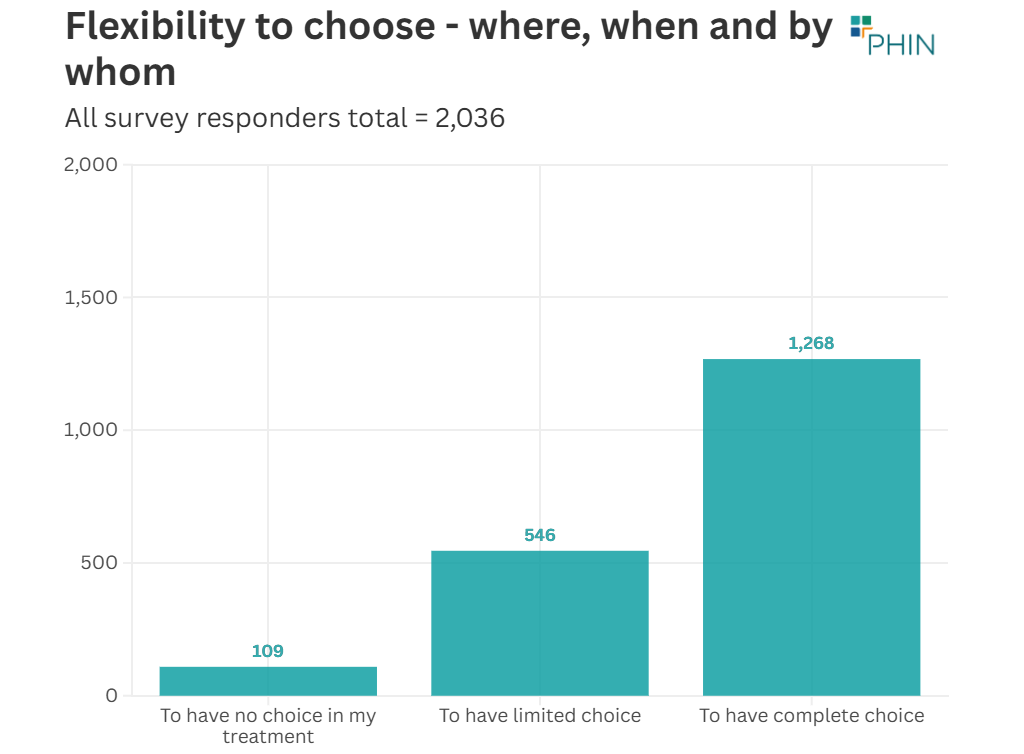
The selection of ‘to have no choice’ above may instead represent those overwhelmed by the prospect of researching but not actually less interested in doing so.
Very few respondents selected that they would like ‘no choice’ but it is notable and interesting that despite still being low, the rate of Wales respondents selecting this was higher (albeit not significantly) than all other nations.
Is PHIN a trusted source of healthcare information?
PHIN collects private sector surgical data including admissions, adverse events, patient experience and clinical outcomes, across the nations. Our survey suggested there was no difference in the awareness of PHIN by nation. And our website traffic suggests the same, comparing private sector activity to rates of website traffic by nation:
- England represents 89% in both
- Scotland represents 5% in both
- Wales represented 3% of the market and 4% of website traffic
- Northern Ireland 2% of market activity and 3% of website traffic.
PHIN received over 42,000 visitors from devolved nations, and over 400,000 visitors in total, in 2024. Patients across nations value PHIN’s data, and we are striving to ensure the data quality is matched across nations.
We can see that patients in the devolved nations may differ from England and each other in terms of the information they look for and their approach to making private healthcare decisions.
PHIN is striving to ensure we not only have comprehensive data coverage but that we cater to the needs of all patients across the UK. Considering the equal proportionality of visitors to the PHIN website and the private sector patients by nation, we seem to be posing value equally. And with a 25% growth in visitors in 2025 relative to 2024 and increasingly complete consultant and hospital data, we hope to further our positive impact for patients across nations.
What patients have said about PHIN:
“I had never heard of PHIN, which I'm amazed at… that there's something out there such as this resource.”
Older cataract surgery patient
“It's going to be a part of my journey from now on, it's an excellent site.”
75+ year old woman from London
Conclusion
According to prior research, despite differences in policies around healthcare across the UK nations, implementation and patient experience are not largely different. However, by analysing the results of PHIN’s YouGov survey we found some differences in how the devolved nation patients approached private healthcare.
These findings show a difference in how Northern Ireland respondents may view their decision to go privately (as more of a necessity than a choice) and what they place importance on (less on safety factors and more on word-of-mouth recommendations). It also highlighted more uncertainty among Wales respondents in how they should research their private healthcare options.
PHIN, as well as other sources of healthcare information, including hospitals, should work to ensure that all nations of the UK have the information they need to be able to make informed healthcare decisions.