Healthcare in the UK has been a devolved matter since 1999, and in the years since, the landscape of healthcare provision and patient choice across England, Scotland, Wales, and Northern Ireland has continued to evolve. We are interested in how this impacts patients’ views on healthcare, so we have revisited our patient research to see what they say. This is the first blog post exploring those issues.
At PHIN, we are committed is to harnessing data and insight to illuminate the healthcare sector, ensuring that patients, providers, and policymakers alike have the information they need to make informed decisions. In 2024, PHIN conducted and published research on patient priorities when it comes to private healthcare. We have revisited this research to specifically explore devolved nation patient needs. The sample sizes in this research for respondents from the devolved nations are small and not statistically representative, but we think they’re worth sharing as they can give an indication of the situation – or at least help people to ask the right questions about devolved healthcare.
According to prior research, despite differences in policies around healthcare across the UK nations, implementation and patient experience are not largely different. However, by analysing the results of our nationwide survey, we found some differences in how the devolved nation patients approached private healthcare.
PHIN – as well as other sources of healthcare information, including hospitals – should work to ensure that all nations of the UK have the information they need to be able to make informed healthcare decisions.
What do the different UK populations think about healthcare?
In 2024, PHIN ran a UK-wide YouGov survey asking patients about their priorities and understanding of choice when it comes to private healthcare treatment, focusing on those who had received private healthcare treatment in the past three years or would consider getting private treatment in the next three years. This survey received 2,036 responses: 1,712 from England, 171 from Scotland, 98 from Wales and 55 from Northern Ireland.
We analysed the responses to identify potential trends and differences across the nations. The aim was to help patients and healthcare providers better understand unique nation needs, and for PHIN to increase its understanding of the patients we serve.
Overall, we uncovered apparent attitude differences in Northern Ireland and Wales, but no distinct differences in Scotland:
- Northern Ireland respondents appeared to view private healthcare as more of a necessity than a choice.
- Northern Ireland respondents focused less on private healthcare safety than other those in other UK nations.
- Northern Ireland respondents placed more trust in word-of-mouth recommendations of healthcare providers than those in England, Scotland or Wales.
- Wales respondents expressed less certainty than other nations in where and how to research their private healthcare options.
- Awareness of PHIN is proportional across the devolved nations.
What do patients think about NHS waiting lists?
‘NHS waitlists and treatment unavailability’ emerged as the primary reason patients chose private treatment, with this trend consistent across all UK nations and age groups.
“[The NHS is] just on its knees, it's absolutely on its knees and so many people are really struggling with long waiting lists times... You're leaving people to a point where they're completely broken before you're fixing them and then their recoveries are a lot more complicated, [and] their outcomes are less favourable.”
Young self-funded patient and NHS nurse seeking private treatment
The survey results indicated that this sentiment was especially pronounced among those from Northern Ireland, as well as women across the UK.

The four nations measure NHS waiting lists in different ways meaning that comparison is difficult. While these results might suggest longer waitlists in Northern Ireland and may suggest that women are disproportionately affected by this across nations, we don’t have evidence to state this conclusively.
What do different nations think about patient choice?
The strength of this response may also suggest a cultural difference in Northern Ireland, where private care is treated as more of a necessity than in the other nations.
This theme of ‘patient choice’ being given less importance in Northern Ireland is continued where choice of consultant/hospital was proportionally a much lower consideration for going private versus other nations.
On the other hand, these respondents selected quality of consultants/hospitals as a reason at roughly the same rate as the other nations, indicating that choice importance was not driven by perceived difference in the quality of private care.
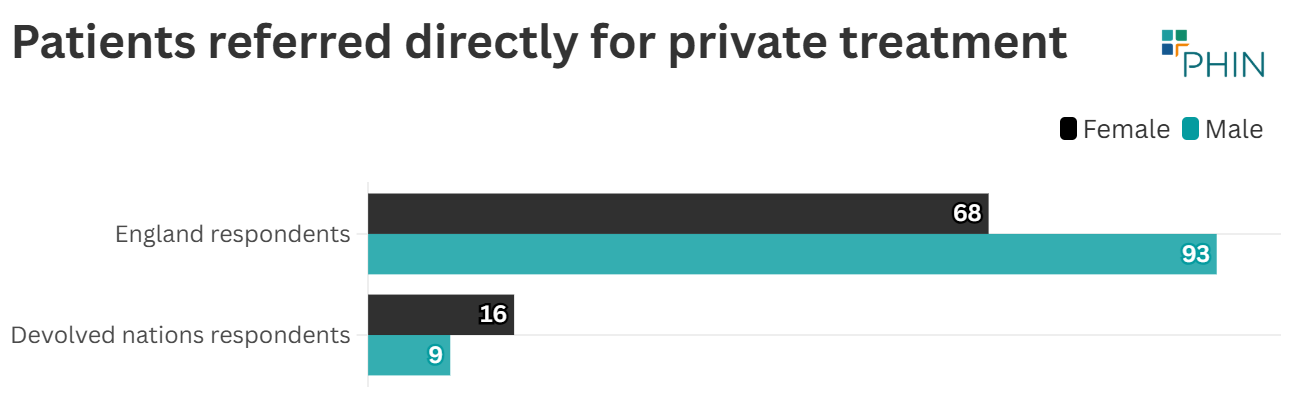
In terms of given choice, it appears that women in the devolved nations were disproportionately affected. Women in the devolved nations stated that they were directly referred for private treatment (rather than given a range of providers) at a higher rate than men, while this effect was reversed in England.
It is also worth noting that choice can be limited by geography, with far more private providers/hospitals operating in England than in Scotland, Wales or Northern Ireland. Our report Distance to diagnosis and treatment shows that private patients in Northern Ireland travel, on average, more than double the distance for treatment than private patients in England.
As I mentioned at the beginning, the sample size overall is quite low, so whether this is truly representative of actual differences in treatment pathways by gender and nation is unclear. However, it may relate to this difference in perceived necessity versus desire to go private, particularly prevalent among women in the devolved nations that we surveyed.
Something to think about!
References
Peckham, Stephen; Mays, Nicholas; Hughes, David; Sanderson, Marie; Allen, Pauline; Prior, Lindsay; Entwistle, Vikki; Thompson, Andrew; Davies, Huw (2012) Devolution and Patient Choice: Policy Rhetoric versus Experience in Practice. Social policy & administration, 46 (2). pp. 199-218. ISSN 0144-5596 DOI: https://doi.org/10.1111/j.1467-9515.2011.00831.x