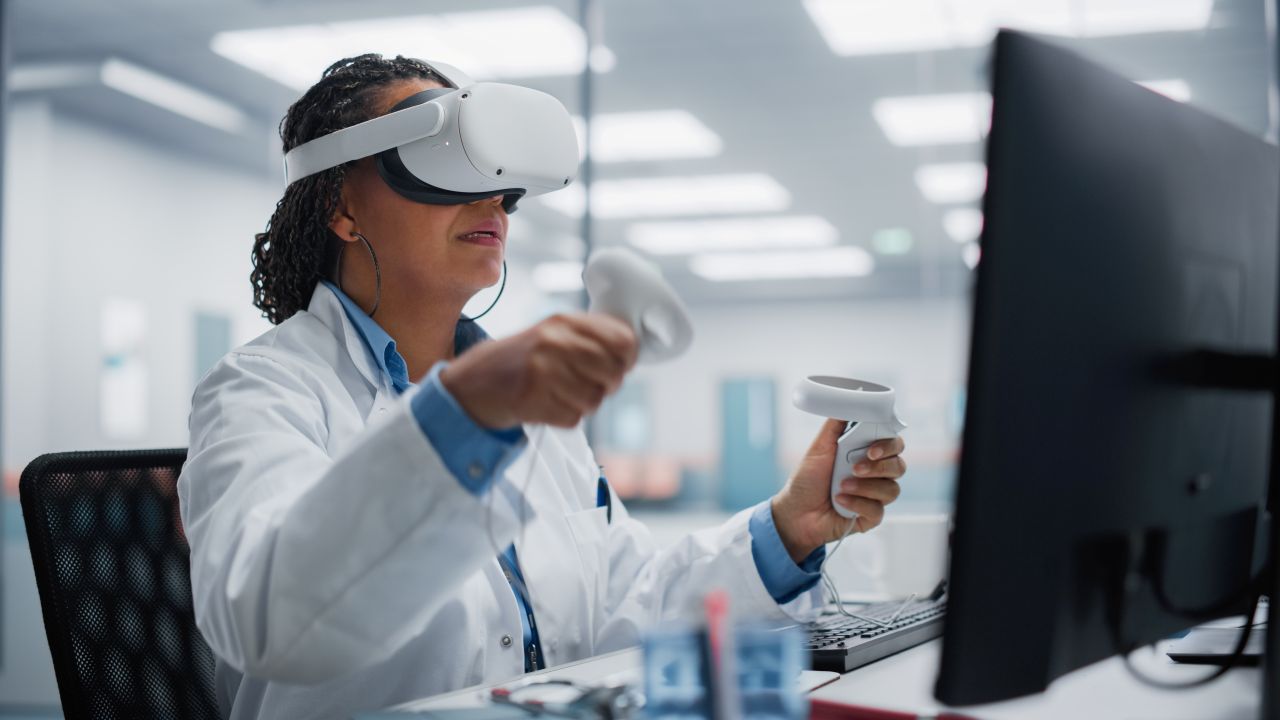
What if your surgeon could perform your exact operation 10 times before ever making the first cut? In the UK, this isn’t science fiction; it's the reality of surgical preparation.
This is the world of virtual reality surgery. Think of it as a flight simulator for surgeons, where virtual reality (VR) surgical training in the NHS lets them master a patient’s unique anatomy making complex operations safer for everyone. The surgeon still conducts the operation themselves, but they get to practise first using the technology in the same way a pilot practises flying.
How a CT scan becomes a virtual operating theatre
The journey from a hospital scan to a virtual surgery begins with something familiar: a patient’s CT or MRI. Powerful surgical simulation software platforms then act like a digital sculptor, taking those flat image 'slices' and building them into an interactive 3D model. Suddenly, an organ or spine isn't just a black-and-white picture; it’s a perfect virtual replica of the patient's unique anatomy that a surgeon can explore from any angle.
Seeing the model is one thing, but feeling it is what makes this practice so powerful. Through special controllers, surgeons can actually feel the resistance of tissue or the hardness of bone. This technology, known as haptic feedback in surgical training , adds a crucial sense of touch, allowing surgeons to build muscle memory and experience how different structures will react to their instruments in a remarkably lifelike way.
This combination of sight and touch is already transforming preparation for real-world procedures. For instance, teams in UK hospitals can rehearse a complex tumour removal on a virtual copy of a patient's kidney, planning the safest route before ever making an incision. This is a key example of how VR helps surgeons practise , and this new level of preparation is leading to direct benefits for patient safety across the country.
Three ways VR is making surgery safer across the UK
This new level of preparation translates directly into clear, measurable improvements in patient safety and surgical success. The ability to practice on a perfect digital twin of a patient before an operation is leading to these advances.
Experts point to three major ways VR is directly benefiting patient care:
- Better planning for complex cases: Surgeons can map out the safest approach for tricky procedures, navigating a patient’s unique anatomy without any risk.
- Mastering rare conditions: A surgeon might only see a particular condition once in their career. VR lets them practice that exact procedure repeatedly, building vital experience.
- Improving surgical accuracy: Repeated practice in the simulation builds muscle memory, helping surgeons perform with greater precision and confidence when it counts.
Ultimately, this all translates into better patient outcomes with VR-assisted surgery .
Hospitals using these simulations report that well-rehearsed teams can often perform operations more quickly and with fewer complications. For the patient, this can mean a shorter time under anaesthesia and a smoother road to recovery.
Is the future of surgery already here?
Virtual reality in UK hospitals is transforming complex procedures into familiar territory. By allowing doctors to practice on a perfect digital copy of their patient, this technology builds the muscle memory and confidence that lead to safer outcomes for everyone.
VR technology could also make operations less stressful for patients and recovery more relaxing , improving the patient experience and potentially improving their outcomes.
The journey doesn’t stop there. The future of surgical procedures with VR is evolving into Augmented Reality, projecting that digital map directly onto the patient in the operating room - giving our best surgeons even better vision.