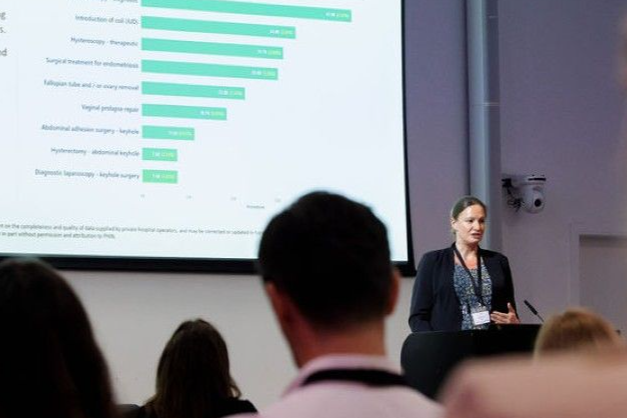
PHIN's Digital and Analytics Operations Director, Nathalie Alpi, spoke at LaingBuisson's Women's Health and Femtech Conference on 21st October 2026. Using PHIN data on every quarter from the start of 2022 to the end of 2025, she looked at how women use private healthcare, how they pay for it, and what that tells us about where the sector is going.
Women are the largest group of patients in UK private healthcare. Between Q1 2022 and Q4 2025, they accounted for around 55% of private hospital admissions in every quarter. Over the same period, total private admissions grew by 16%, from around 208,000 to around 242,000 a quarter.
So while demand has grown, the balance between women and men has stayed the same. What has changed is which women are using private care, how they are paying for it, and what they are using it for. Because women make up most private patients, those changes give an early view of where private healthcare as a whole is heading.
Insurance is driving growth
By the end of 2025, 68% of female private admissions were funded by private medical insurance (PMI), up from 65% at the start of 2022. Self-pay admissions among women stayed broadly flat, at around 41,000 a quarter.
With insured activity growing and self-pay holding level, the gap between the two widened from around 31,000 admissions a quarter at the start of the period to around 42,000 by the end. Growth in women's use of private healthcare is coming mainly through insurance.
Working-age women are leading demand
That insured growth is concentrated among women of working age. Around three quarters of PMI-funded female admissions are for women aged 30 to 69, and women aged 40 to 59 alone account for around 45% of insured activity.
The fastest growth has come from women aged 30 to 39. This suggests more women are looking for earlier access to care during the years when they are most likely to be working, rather than later in life.
What women use private healthcare for
Women's private healthcare covers far more than maternity and gynaecology. Almost half (46%) of all female admissions are in three high-volume specialties: trauma and orthopaedics, ophthalmology and general surgery.
Women also make up a large majority of patients in some specialties. They account for 90% of plastic surgery activity, and around 69% of medical oncology and 66% of clinical oncology activity.
Gynaecology provides a high and steady base of demand, with between 12,000 and 14,000 admissions a quarter throughout the period. Women aged 40 to 49 account for the largest share of these.
Growth is moving towards diagnosis and ongoing care
The specialties growing fastest are increasingly those linked to diagnosis, monitoring and managing long-term conditions, rather than one-off elective procedures.
Clinical oncology grew by around 40%, the strongest growth of any specialty, rising from around 3,400 to 4,700 admissions a quarter.
Gastroenterology grew by around 17%. Women under 50 drove most of this, and diagnostic procedures such as endoscopies and colonoscopies made up a large part of it.
Growth in plastic surgery and ophthalmology, by contrast, has slowed since 2022.
Taken together, this points to private healthcare being used more for earlier intervention and continuing care.
Endometriosis-related care is growing quickly
Within gynaecology, diagnostic and reproductive health procedures remain the largest areas of activity, and the three highest-volume procedures have all grown steadily, at a similar rate.
Some of the fastest growth, however, is in smaller groups of procedures linked to endometriosis, including therapeutic hysteroscopies, surgical treatment of endometriosis and treatment of abdominal adhesions.
Across gynaecology, growth is happening on both diagnostic and treatment pathways, and the rise in endometriosis-related procedures reflects growing national demand. It suggests more women are turning to private healthcare for earlier investigation and treatment of chronic conditions.
Growth in these procedures is not linked to how common they are. Some smaller procedures are growing much faster than the largest ones.
Needs change across a woman's life
Women of different ages use private healthcare in very different ways.
Women aged 0 to 29 mainly use private care for diagnostics, reproductive health and aesthetic procedures. Diagnostics are growing in this group: since 2022, colonoscopies have risen by 41%, endoscopies by 30% and hysteroscopies by around 70%. Coil fittings have nearly doubled, from around 260 to 505 a quarter. The numbers are small, but the rate of increase stands out.
Women aged 30 to 59 account for most reproductive health activity, including around 83% of hysteroscopies and 80% of IUD procedures. This group also accounts for 62% of colonoscopies and 61% of chemotherapy procedures for female patients. Chemotherapy has grown by around 10% since 2022.
Women aged 60 and over mainly use private care for joint replacements and cataract surgery. This age group accounts for over 80% of each of these procedures among female patients.
What this means for the future of private healthcare
Nathalie closed with four takeaways:
- Women consistently account for around 55% of private hospital admissions and remain a major driver of demand across the sector.
- Growth is increasingly supported by insured patients, particularly women aged 30 to 59.
- Demand is growing beyond traditional elective surgery into diagnostics, oncology and managing long-term conditions.
- Rising activity in gynaecology and endometriosis-related procedures suggests growing demand for earlier diagnosis and intervention.
Women's healthcare trends give an early indicator of how use of private healthcare is changing across the wider sector. More patients are coming forward earlier, through insurance, for diagnosis and for ongoing care. That has implications for how providers plan capacity in areas such as diagnostics and oncology, and for the information patients need when they choose where to be treated.
About the data
PHIN is the government-mandated, independent body that reports on UK private hospital and consultant activity and trends. Figures in this article cover private hospital admissions from Q1 2022 to Q4 2025. The accuracy of the information depends on the completeness and quality of data supplied by private hospital operators, and it may be corrected or updated in future.