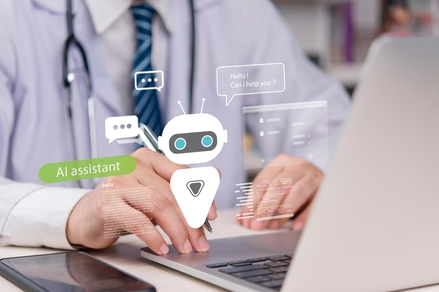
Artificial intelligence (AI) is becoming part of everyday life, and it is increasingly being used in healthcare.
AI can help healthcare professionals examine scans, analyse large amounts of information and spot things that may need closer attention. It can also help patients find and understand health information.
But AI is not perfect. It can make mistakes, so it is particularly important to use it carefully when your health is involved.
What is AI?
Artificial intelligence is a broad term used for computer systems that can learn from information and use it to carry out tasks. In healthcare, the important point is that AI should support people, not replace them.
How could AI help patients?
Making health information easier to find
Healthcare can be confusing if you do not know the medical terms to search for. AI can help you with this.
PHIN is developing an AI-powered search tool designed to understand everyday language. For example, someone searching for "my vision has become cloudy and bright lights have halos around them" could be directed towards information about cataract surgery. The tool helps people find relevant information. It does not diagnose them.
PHIN is also exploring how AI assistants such as Claude, Copilot and ChatGPT could access accurate, up-to-date information from PHIN in the future. This work is still being developed and is due to launch in 2027.
Helping healthcare professionals
AI can analyse large amounts of information quickly and highlight things that might need closer attention.
For example, some NHS and private hospitals use AI as an extra ‘pair of eyes’ when healthcare professionals look at X-rays, CT scans, MRIs and other medical images. It may help spot possible abnormalities or identify cases that need urgent attention. This may mean patients get more accurate test results and sooner than if AI wasn't used.
However, using AI does not automatically make healthcare better. It still needs to be shown to work safely and effectively.
What happens if you ask AI to...?
One advantage of AI is that you can ask it to tailor an explanation or a set of questions around your life and what matters to you. Here are three prompts you can experiment with.
1. Get ready for an appointment
“I'm seeing a doctor about [condition or treatment]. Ask me five questions about my life and priorities, then suggest questions I might want to ask my doctor, including some I may not have thought of.”
2. Make a complicated condition make sense to you
“I love [football/gardening/cooking/gaming/history]. Explain [condition] using an analogy based on that. Then tell me where the analogy stops being medically accurate.”
3. Become a private healthcare detective
“I'm considering having [procedure] privately. Ask me what matters most to me, then give me a detective's checklist of things I could investigate before choosing where to have it. Tell me where I could check each one.”
What are the risks?
AI can be useful, but there are some important things to remember.
AI can get things wrong.
AI-generated answers can be inaccurate or inconsistent. You should not use a general AI chatbot to diagnose a medical condition or as a replacement for advice from an appropriately qualified healthcare professional.
It may not work equally well for everyone.
AI systems learn from information. If that information does not properly represent different groups of patients, the technology may work better for some people than others.
Think carefully about your personal information.
Health information is very personal. Be cautious about entering information that identifies you, or sensitive information about your health, into publicly available AI services. PHIN's developing AI search tool does not use patient health data.
People are still responsible.
Healthcare organisations need clear rules about how AI is chosen, checked and used. Some AI healthcare software is also regulated as a medical device in the UK.
Five questions to ask when using AI for health information
If you use an AI tool to look for health information, ask yourself:
- Where has this information come from? Is it a source you can trust?
- Is it up to date? Health advice and guidance can change.
- Can I check it? Look at the original source where possible.
- What am I sharing? Be careful with personal or medical information.
- Do I need professional advice? Do not treat an AI answer as a medical diagnosis.
AI is a tool, not the answer
AI could make it easier for healthcare professionals to use information and for patients to find information they understand. But new technology does not automatically mean better healthcare.
At PHIN, we believe you should not need to understand complicated medical language to find useful information about your healthcare. AI could help connect the questions people naturally ask with reliable information that helps them make informed choices.
But the final decisions about your health should involve people, not just technology.
PHIN does not recommend individual healthcare providers, treatments or AI services. You should discuss decisions about your care with an appropriately qualified healthcare professional.
In short
AI could help by:
- supporting healthcare professionals
- analysing large amounts of information
- making some tasks quicker
- making health information easier to find and understand.
But remember:
- AI can make mistakes
- it may not work equally well for everyone
- your personal information needs protecting
- it should support, not replace, healthcare professionals.