Today is Thursday, which might not feel especially significant. But if you are in a private hospital today, you are more likely to have company.
Our data shows that Thursday is consistently the busiest day for private hospital admissions. Activity usually builds from Monday, peaks in the middle of the week, and then drops off towards the weekend.
This article is based on analysis by Chun-Wei Tsai, Data Quality Analyst at PHIN. It uses UK private hospital data covering planned treatment between 2022 and 2024.
A typical week in a private hospital
Looking across more than 2.7 million private hospital admissions, there is a pattern:
- Monday – Busy, but still building
- Tuesday – The busiest day for patients staying overnight
- Wednesday – High activity continues
- Thursday – The busiest day overall
- Friday – Activity starts to fall
- Saturday – Much quieter
- Sunday – The quietest day by far
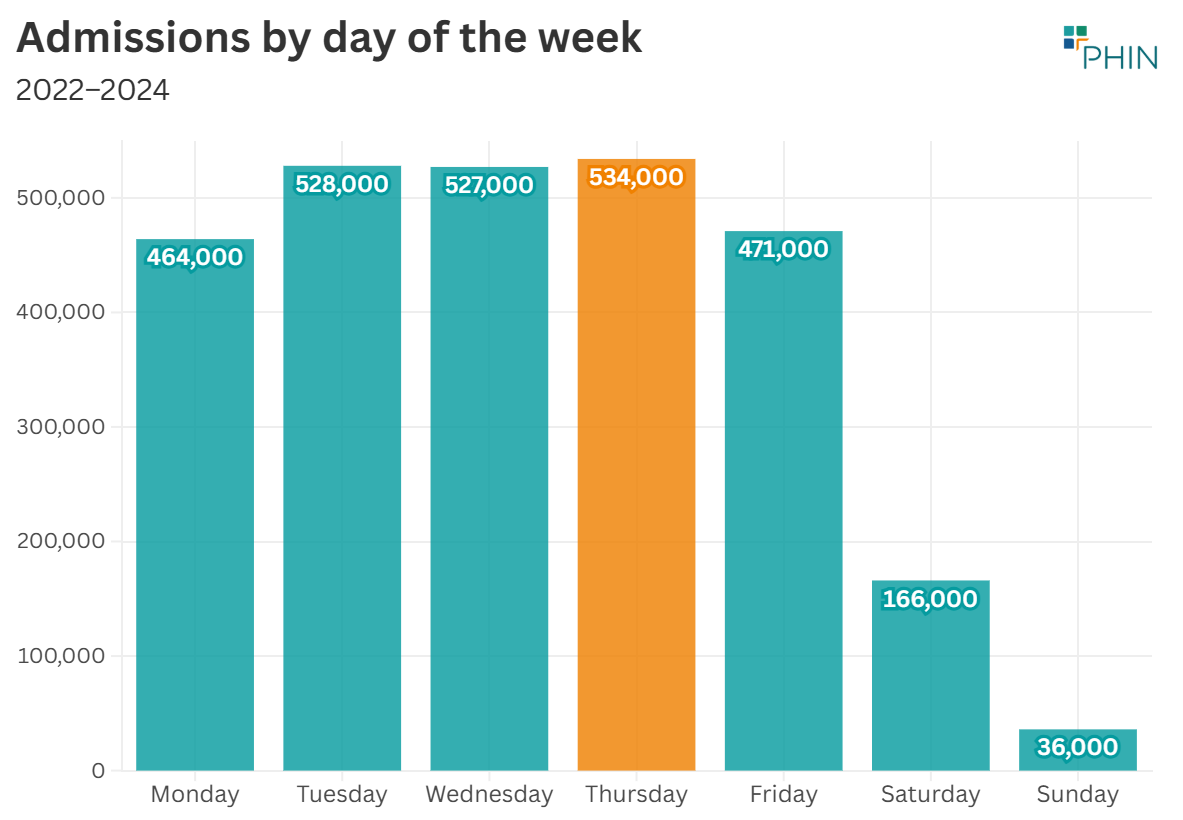
Not all treatment peaks on the same day
The busiest day depends on the type of treatment:
- People staying overnight (inpatients) most often arrive on Tuesday
- Operations for people going home on the same day (day cases) are most common on Thursday
This is due to how hospitals organise care. Patients staying overnight are often admitted earlier in the week so that recovery, tests and discharge planning can happen on the following weekdays. Same-day procedures are easier to schedule later, once the week is fully up and running.
Why does most care happen midweek?
Most private hospital treatment is planned in advance, rather than urgent. This allows hospitals to schedule care at times when the widest range of staff and services are available.
The middle of the week is when hospitals typically have full access to diagnostic services, pharmacy support and specialist clinical teams. Starting treatment earlier in the week also allows time for follow-up care before the weekend, when fewer planned services usually run.
What about the weekend?
Some specialties, such as plastic surgery and gynaecology, run more weekend lists than others. These tend to be services where hospitals have set up specific weekend programmes, with the right staff and support in place.
Are there differences across the UK?
Yes, although the overall picture is similar everywhere:
- In Wales, activity often stays higher into Friday
- In Scotland and Northern Ireland, admissions tend to peak slightly earlier, often on Wednesday
These differences reflect local ways of organising services and staffing, rather than differences in standards or quality of care.
What does this mean for patients?
For most people, these patterns do not affect the quality of care they receive. But they can shape what a hospital feels like.
If you go into hospital between Tuesday and Thursday, it is likely to be busier, with more patients coming and going. The benefit is that the full range of planned services is usually available. Mondays and Fridays are often a little quieter. At weekends, there are fewer planned procedures, depending on the type of treatment.
You may also notice that appointment options are more limited outside the middle of the week. This is because hospitals concentrate most planned care on the days when services are fully in place.
Every patient’s situation is different, and hospitals will still take individual needs and timing into account when arranging care.
But if you are offered a midweek appointment, there is usually a practical reason behind it.
The analysis in this article was first published in Healthcare Markets magazine and has been adapted for publication on the PHIN website.