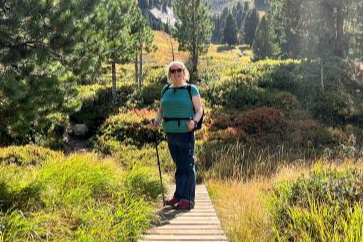
Natalie from Farnsfield in Nottingham experienced extreme pain and bloating for more than a year due to an abdominal hernia. An abdominal or ventral hernia occurs when tissue or organs push through a weakness in the abdominal wall, creating a visible bulge that can be painful and affect day to day life. Some people also experience restricted movement, digestive problems and difficulty breathing. Here Natalie shares her story to help other patients who may be having similar experiences.
Natalie works as a forensic paediatrician on a busy children’s ward, a role that involves regular lifting and long periods on her feet. Her hernia developed in 2019 following laparoscopic surgery and soon began to affect both her professional and personal life. She found herself battling through pain at work, unable to exercise or enjoy gardening and struggling with the impact the swelling had on her body confidence.
“I was getting more exhausted at work and having to brave the pain every day. Bending down was becoming harder and I couldn’t take time off. I also sing in a barbershop chorus which involves standing and moving for long periods. This became difficult too.”
At times the pain was so severe that Natalie feared she might have a strangulated hernia, a complication that requires urgent treatment. She knew she needed help.
“I felt embarrassed of my belly and became more withdrawn. I was mortified when someone thought I was pregnant so I stopped going out socially as often.”
Meeting a consultant and exploring treatment
Natalie arranged to see consultant bariatric and pancreatic biliary surgeon Mr Altaf Awan at The Park Hospital . She describes the experience of meeting him and the wider multidisciplinary team as extremely positive.
Mr Awan recommended robotic surgery for her condition. Robotic surgery is a form of minimally invasive treatment that uses advanced technology to support precision and control. Procedures can be carried out through small incisions which may help reduce discomfort, limit blood loss and support a quicker recovery. The system provides 3D high-definition views and enhanced instrument dexterity, which can assist surgeons when performing complex procedures.
“Everyone was absolutely lovely. When I went for my pre op appointment my dad had died unexpectedly the night before and I was an absolute wreck. Everyone I interacted with was so kind and supportive. When I realised afterwards that I had forgotten my ECG they arranged for it to be done on the day of my operation.”
Natalie says staff kept her informed throughout. “On the day of the procedure there was a delay in getting the anaesthetist. Mr Awan phoned my husband personally so he would know what was happening. The nursing staff made sure I was okay while we waited.”
After surgery, Natalie was visited by Mr Awan both after she woke up and again the next morning. “He came to check I understood the procedure and the aftercare plan.”

A wider diagnosis that changed Natalie’s life
During her care, Natalie also spoke to Mr Awan about long standing gastrointestinal symptoms that had been affecting her life and sleep for years. “I told him I had IBS that caused me to get up 10 to 15 times a night. I had already had a colonoscopy and had been told nothing else could be done.”
Mr Awan suggested investigating bile acid malabsorption, a condition Natalie was unfamiliar with despite her clinical background. With his letter of support, her GP was able to start a trial of treatment which confirmed the diagnosis.
“It turned out he was right. I am now on medication, I sleep through the night and I can go about my day without worrying about accidents. At work I can now eat lunch and still run an afternoon clinic. It has changed my life.”
Natalie says that both the surgery and the broader holistic approach to her health had a significant positive impact. “Quite aside from the hernia operation, his diagnosis and kindness have changed my life. I am grateful for the chance to thank him publicly.”
Disclaimer
We are very grateful to Circle Health Group – one of the providers we collect data from – and the team at The Park Hospital for sharing Natalie’s story with us so that we can share it with you. However, please note that PHIN provides information to support your healthcare decisions, but we do not recommend individual providers. It’s important that you explore all your options before choosing where and how to receive treatment.
Some patients may base their decision on the cost of treatment (if they are self-funding), while others may follow the guidance of their private medical insurer. Others might prioritise the experience of the consultant or factors related to the hospital, such as its regulator rating, location, or facilities.
We encourage you to research thoroughly and make an informed decision that’s right for you. We’re sharing Natalie’s story to help you understand what your experience might be like and to support you in asking the right questions when considering your healthcare options.