October is Breast Cancer Awareness month. Each year, about 55,000 people are diagnosed with breast cancer in the UK. It is more common in people over 50, but it can also affect younger people. A diagnosis of breast cancer can come with many challenges, not least being afraid of what to expect from treatment.
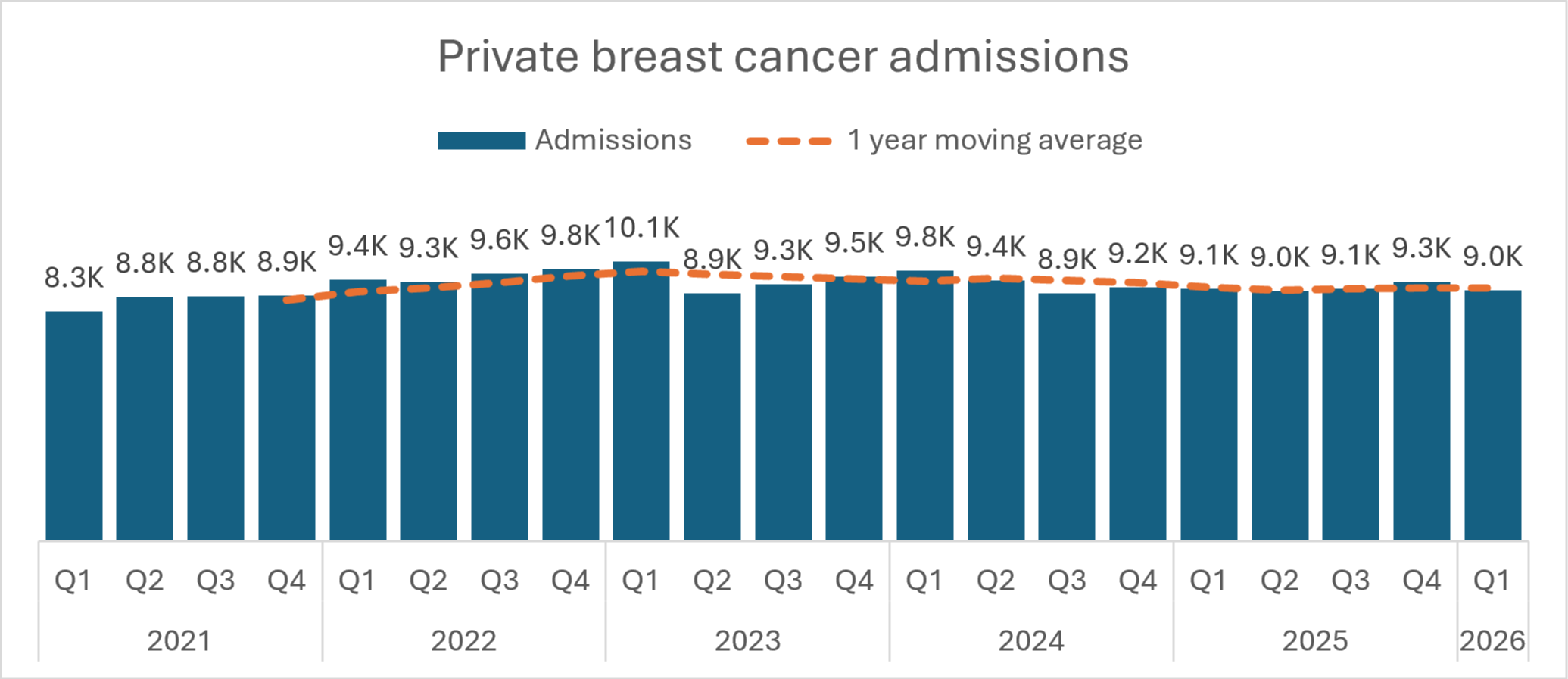
PHIN recorded 36,490 private hospital admissions with breast cancer as the primary diagnosis in the year ending March 2026. A single patient may have more than one admission during their diagnosis or treatment.
Activity was broadly stable, with admissions in Q1 2026 0.6% lower than in Q1 2025.
Key stats
- Breast cancer remains the leading reason for private cancer care admissions in the UK.
- Breast cancer accounted for 29% of private cancer admissions in the year ending March 2026.
- Two in five private breast cancer admissions involved patients under 50.
- Private breast cancer care is not confined to screening-age patients, with four in ten private breast cancer admissions involving people under 50.
- Private healthcare accounts for around one in nine elective breast cancer admissions in England.
The fact that patients under 50 are represented in these statistics is important because NHS breast screening is offered to women aged 50 up to their 71st birthday.
Faster access to a diagnosis and any necessary treatment is the main reason why patients choose to go private when they have health concerns.
Caveats
Figures are based on hospital admissions rather than individual patients. Breast cancer admissions are defined using a primary diagnosis of ICD-10 code C50 and cover inpatient and day-case activity discharged between 1 April 2025 and 31 March 2026.
What are ICD codes?
International Classification of Disease (ICD) are set by the World Health Organization. They serve as the global standards for health data, for clinician documentation at the point of care, and for statistical use.
They are used by governments, health professionals, researchers, laboratories and many other people.